CARRY THE STANDARD 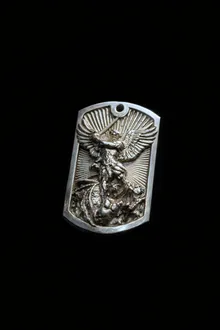
FORGED IN HIS IMAGE.
A medal built for those who stand the line — just like he did.
CLAIM YOUR ST. MICHAEL MEDALCommander of the heavenly host. Defeater of darkness. Patron of every person who stands between harm and the innocent.
Michael — whose name in Hebrew means "Who is like God?" — is one of the few angels named in scripture across multiple faith traditions. He appears in the Hebrew Bible, the Christian New Testament, and the Islamic Quran, making him one of the most universally recognized divine figures in human history.
He is not a symbol of passive grace. Michael is a warrior. In the Book of Revelation, he leads the armies of heaven against the dragon and its forces — and wins. In the Book of Daniel, he is called "the great prince who protects your people." In Jewish tradition, he is the guardian of Israel. In Catholic and Orthodox Christianity, he holds four distinct offices: warrior, angel of death, champion of God's people, and weigher of souls.
Every tradition that knows him agrees on one thing: Michael fights. And he fights for those who cannot fight alone.
The oldest account of Michael's nature is also his most defining. When Lucifer — the highest of the angels — declared himself equal to God and led a rebellion of one-third of the heavenly host, it was Michael who answered. Not because it was easy. Not because the outcome was certain. Because someone had to stand.
That is the essence of what Michael represents: not the courage of the fearless, but the courage of those who understand exactly what they face and step forward anyway.
"And there was war in heaven. Michael and his angels fought against the dragon, and the dragon and his angels fought back. But he was not strong enough, and they lost their place in heaven."
— Revelation 12:7–8
The iconography that has endured for centuries shows Michael in full armor, sword raised, standing over a defeated adversary. It is not a gentle image. It was never meant to be. It is the image of someone who ran toward the threat — and didn't stop until the threat was gone.
Over centuries, those whose vocation places them between danger and the innocent have claimed Michael as their own. The logic is not complicated: he is the original protector. The one who stood the line when everything was on the line.
Michael has been the patron of soldiers since at least the 4th century. Warriors heading into combat have carried his image for over 1,700 years.
Police officers invoke St. Michael as patron of their profession — the one who enforces divine order, who subdues evil without becoming it.
Those who run into burning buildings while others run out. Michael's intercession is sought by firefighters and paramedics around the world.
Sailors and aviators — people whose lives depend on navigating dangerous environments — have long sought Michael's protection over the journey.
Healers who work at the border between life and death. Michael, who is said to escort souls, is their ancient guardian.
For billions of Catholics, Orthodox Christians, and others, Michael is the defender of the faithful — the one who stands watch over those who believe.
Written by Pope Leo XIII in 1886, this prayer has been spoken by soldiers before battle, by officers at the start of shifts, by firefighters before they enter a structure. It is not a prayer of comfort. It is a prayer of confrontation.
Saint Michael the Archangel, defend us in battle. Be our protection against the wickedness and snares of the devil. May God rebuke him, we humbly pray; and do thou, O Prince of the Heavenly Host, by the power of God, cast into hell Satan and all the evil spirits who prowl about the world seeking the ruin of souls.
— Prayer to Saint Michael, Pope Leo XIII, 1886
The language is military. Defend. Battle. Protection. Cast into hell. This is not incense and candles. This is a call to arms addressed to the one figure in the divine order whose entire identity is built around the act of standing between darkness and the people who deserve to be protected from it.
In an age of skepticism, something interesting persists: the people who face the most danger are often the ones who carry a St. Michael medal. Law enforcement officers. Combat veterans. Firefighters. Not as superstition — as statement.
Carrying Michael is an act of alignment. It says:
I have chosen a side. I stand between harm and the people I protect. I am not neutral.
For people who make that choice every day — who put on a uniform, who deploy, who run toward the call — the image of an archangel who made the same choice resonates in a way that no secular symbol can replicate.
There is also comfort in the continuity. The soldier in Fallujah carrying a Michael medal is connected — through the same image, the same name, the same prayer — to the Roman legionnaire who carried him in 300 AD, to the Crusader knight in 1099, to the American GI in 1944. The protector's vocation is ancient. Michael is older than all of them.
"Who is like God?" — the question encoded in his name — is not rhetorical. It is a challenge. No one is. And Michael enforces that answer with a sword.
A medal built for those who stand the line — just like he did.
CLAIM YOUR ST. MICHAEL MEDAL